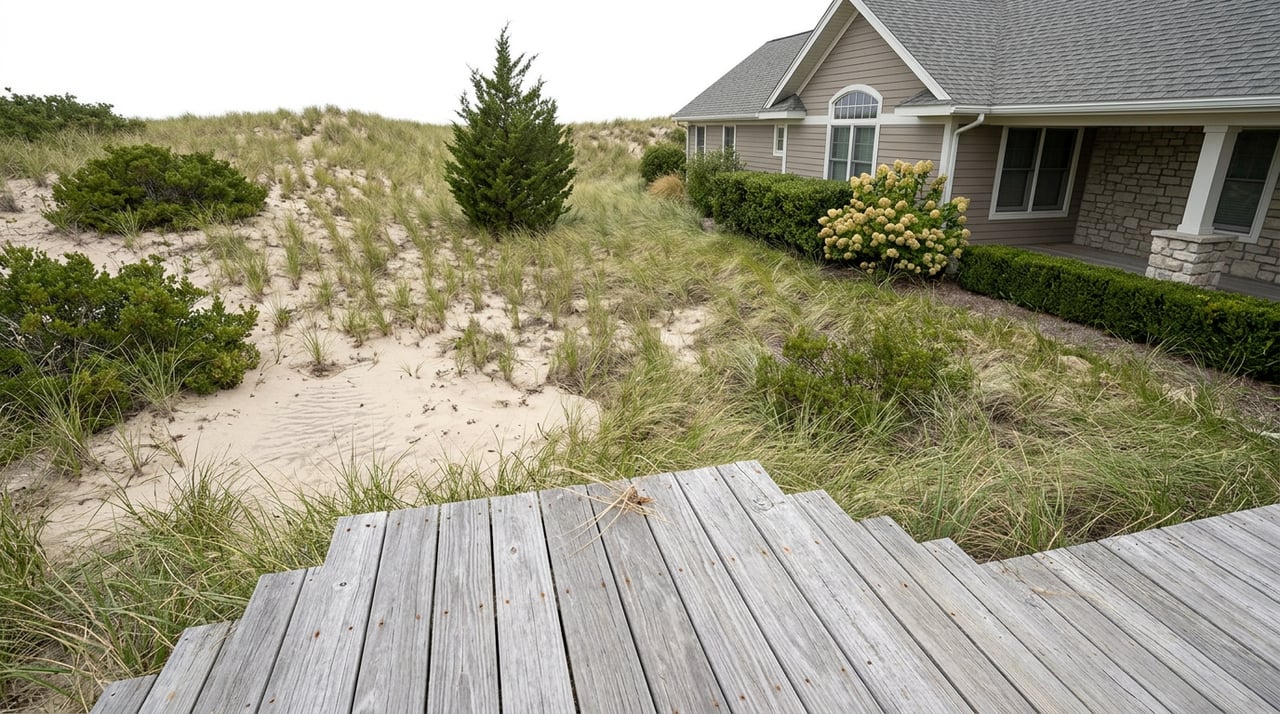
If you're shopping vacant land along the Lake Shore corridor this fall, a question worth asking before you fall for a wooded lot with a peek of blue water: when was the dune boundary on this parcel last checked?
Most buyers assume the answer doesn't matter, because the rule they've heard is old and simple. Land in a critical dune area is restricted. Land outside one isn't. That line has existed since 1989, so surely everyone selling or buying along the lakeshore already knows which side of it their lot sits on.
Here's the part that changes the math: the line itself was just redrawn. The Michigan Department of Environment, Great Lakes, and Energy spent 2024 through 2026 completing the first full re-delineation of the state's critical dune areas since the original 1989 Atlas, covering the 19 lakeshore counties, Ottawa among them, where those boundaries were originally drawn. A parcel that was outside the dune designation in 1989 is not guaranteed to be outside it now. Neither is the reverse. The listing sheet, the seller's old survey, and the assumption everyone's been working from may describe a boundary that no longer applies.
What Actually Changed in 2026
The original 1989 designation covered roughly 74,000 of Michigan's approximately 225,000 acres of Lake Michigan and Lake Superior dunes, chosen because they represented the tallest and most ecologically significant formations along the shoreline. The rules attached to that designation weren't static either. The Michigan Association of Planning says the law, when first adopted, prohibited construction on the lakeward side of dunes outright. In 2012, state regulators relaxed that standard.
Now there's a third data point: an actual re-delineation, completed this year, revisiting boundaries that had rested on a 1986 natural features inventory ever since. For a buyer, that means the safest assumption isn't "check the 1989 map." It's "check the current map, because the 1989 map may no longer be the map."
The Michigan Legislature says construction is barred on the first lakeward-facing slope of a critical dune area, with one narrow exception: lots of record platted before July 5, 1989 that simply don't have enough buildable ground landward of the ridge crest.
That exception matters more than it looks. If a parcel's dune status shifted in the 2026 delineation, a lot that was buildable under the old boundary might now fall inside a restricted zone, and the pre-1989 carve-out could be the only thing standing between a buyer and a lot with no legal building envelope at all.
The Permit Chain Nobody Explains Upfront
Assume the parcel does sit inside a designated critical dune area, confirmed or not. Building there doesn't run through one office. It runs through a stack:
- According to the Ottawa Conservation District, EGLE Part 353 permits are required for house and garage construction, driveways, septic systems, retaining walls, and sand removal. Confirm the current fee schedule for your specific project before budgeting.
- A Vegetation Assurance form is also part of the process. The Ottawa Conservation District, based in Grand Haven, will complete this form for a $250 fee.
- A county soil erosion and sedimentation control permit is also part of the process.
- If the parcel also sits in a High-Risk Erosion Area, confirm what that designation means for the project.
None of these fees will bankrupt a land purchase on their own. What catches buyers off guard is the sequencing. A soils test or a builder's site visit can happen quickly. A Vegetation Assurance form and an EGLE permit review cannot, and skipping the order costs time, not just money.
Whose Desk the Permit Actually Lands On
Here's the wrinkle that's easy to miss if you're used to calling the township for a building permit and assuming that call covers everything. Along this stretch of the Lake Shore, most communities don't administer their own dune program. EGLE issues Part 353 permits directly in nearly every lakeshore jurisdiction in the state, and that includes the townships along this coast. Port Sheldon Township's building department will tell a caller as much: critical dune and high-risk erosion questions route to the state, not the township counter.
That doesn't mean the local building department is irrelevant. It just means it's one call among several, not the only one. PermitMint says Grand Haven Charter Township runs its own building authority separate from the City of Grand Haven's, while Spring Lake Village contracts its building services out to a third-party township services provider rather than staffing it in-house. And inside the city of Grand Haven itself, a shoreline lot can carry a fourth layer on top of the dune question: if it sits within the downtown historic district along Washington Avenue, exterior changes and new construction need a separate review from the Historic Conservation District Commission, on top of whatever EGLE requires for the dune.
A buyer who confirms with one office that a project is fine has often confirmed with the wrong office, or only one of several correct ones.
What This Does to the Number on the Lot
Here's where the redrawn line stops being a permitting inconvenience and starts being a pricing question. Restricting where and how a structure can sit on a lot doesn't just add paperwork. It shrinks the buildable envelope, and a smaller buildable envelope is worth less than a comparable lot without that restriction, even when both lots have identical frontage and identical square footage on paper.
You can see a version of this same effect already playing out in home prices a few miles inland from any dune question. In Grand Haven, homes west of Beacon Boulevard, closer to the beach, have been commanding a premium exceeding $100,000 over comparable properties east of that line, according to early 2026 market data. That's not a dune boundary, but it's the same underlying mechanism: a line on a map that most buyers can't see from the street is doing real work on price. Grand Haven's waterfront-specific median sat at $575,000 in early 2026, up 9.5% year over year, while the city's overall median home price was closer to $438,500 in the same window. The gap between those two numbers is the value of proximity and access. A dune designation works the same way in reverse. It's a line that suppresses buildable area, and buildable area is most of what a vacant lot is actually worth.
Countywide, Ottawa County's housing market overall showed a median price of $400,000 in March 2026, with homes averaging 21 days on market. That's useful as a baseline. It tells you almost nothing about what a specific lakeshore lot with an uncertain dune status is actually worth, because that number gets decided parcel by parcel, not by county average.
Before You Write the Offer
For a lot you're seriously considering, four checks are worth doing before you sign anything:
- Confirm the parcel's current critical dune status against EGLE's updated maps, not against whatever the listing sheet or a prior survey states.
- Ask whether a buildable envelope assessment has been done recently. If the answer is no, or if the last one predates the 2026 delineation, treat that as unfinished business, not a formality.
- Check whether the parcel also falls in a High-Risk Erosion Area, and confirm what that designation means for the project.
- If the lot sits inside an HOA-governed lakefront community, pull the association's financials and ask directly about pending or recent special assessments tied to erosion or bluff stabilization. These are common and frequently left out of the numbers a buyer sees upfront.
None of this makes a dune-designated lot a bad purchase. It makes it a different purchase than the one described on a listing sheet written before anyone checked the new map.
A Few Questions Worth Asking Directly
Does a critical dune designation mean I can't build at all? No. Check the specific parcel before assuming what may be built.
If my lot wasn't in a critical dune area before, could the 2026 update have put it in one? It's possible. The 2026 delineation is a re-assessment, not a rubber stamp of the 1989 boundaries, so a parcel's status is worth verifying directly against the current maps rather than assuming last decade's answer still holds.
Who do I actually call first? Start with EGLE's Critical Dune Area program to confirm designation and permitting authority for the specific parcel, then loop in the local building department for anything outside the dune question itself, such as standard zoning or, in Grand Haven's downtown historic district, exterior review.
If you're looking at a specific parcel along the Lake Shore and want a straight read on what its dune status, permit stack, and pricing actually look like before you write an offer, that's a conversation worth having early rather than after you're under contract. And if you already own lakeshore land or a home nearby and are curious what the current market says it's worth, Ann Huizen can start with an instant home valuation and go from there.
This article is general information, not legal, tax or financial advice. Consult a qualified professional about your situation.